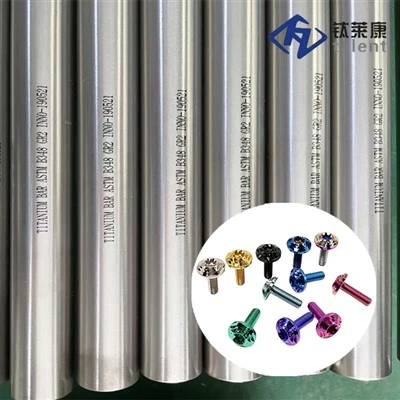
Hey there, fellow metal enthusiasts! I’m a supplier of industrial titanium bars, and I’ve been diving deep into the world of titanium for years. One question that often comes up is how the microstructure of industrial titanium bars affects their properties. Well, let’s break it down and have a chat about it. Industrial Titanium Bars
First off, what exactly is microstructure? In simple terms, it’s the tiny structure of the metal at a microscopic level. It includes things like the size, shape, and arrangement of grains, as well as the presence of any other phases or defects. And trust me, these little details can have a huge impact on how the titanium bar behaves.
One of the most important factors in the microstructure is the grain size. Titanium bars with smaller grains tend to be stronger and more ductile. Why is that? Well, smaller grains mean there are more grain boundaries. These boundaries act as barriers to the movement of dislocations, which are essentially defects in the crystal structure of the metal. When a force is applied to the titanium bar, the dislocations try to move through the material. But the grain boundaries get in the way, making it harder for the dislocations to move. This results in a stronger material that can withstand more stress without deforming.
On the other hand, larger grains can make the titanium bar more brittle. With fewer grain boundaries, dislocations can move more freely, which can lead to cracks forming and the material breaking more easily. So, if you need a titanium bar that can handle high-stress applications, you’ll want to go for one with a smaller grain size.
Another aspect of the microstructure that affects properties is the phase composition. Titanium can exist in different phases, the most common being the alpha and beta phases. The alpha phase is a hexagonal close-packed (HCP) structure, while the beta phase has a body-centered cubic (BCC) structure.
The proportion of alpha and beta phases in the titanium bar can have a big impact on its properties. For example, alpha-phase titanium is generally stronger and more corrosion-resistant, but it’s also less ductile. Beta-phase titanium, on the other hand, is more ductile and can be heat-treated to achieve high strength. So, depending on your specific requirements, you might want a titanium bar with a certain ratio of alpha to beta phases.
Heat treatment is one way to control the phase composition and grain size of the titanium bar. By heating the bar to a specific temperature and then cooling it at a controlled rate, we can change the microstructure and, therefore, the properties of the material. For example, a process called annealing can be used to reduce internal stresses and make the titanium bar more ductile. Quenching and tempering can be used to increase strength and hardness.
The presence of impurities or alloying elements can also affect the microstructure and properties of industrial titanium bars. Some elements, like aluminum and vanadium, are commonly added to titanium to improve its strength and other properties. These alloying elements can change the phase composition and grain size, as well as the way the material behaves under stress.
On the other hand, impurities can have a negative impact on the properties of the titanium bar. For example, oxygen and nitrogen can make the material more brittle. That’s why it’s important to use high-quality raw materials and have strict quality control measures in place during the manufacturing process.
Now, let’s talk about how all of this affects the real-world applications of industrial titanium bars. In the aerospace industry, for example, titanium bars are used in a variety of components, from engine parts to structural elements. The high strength, low density, and excellent corrosion resistance of titanium make it an ideal material for these applications. By carefully controlling the microstructure of the titanium bars, we can ensure that they meet the strict requirements of the aerospace industry.
In the medical field, titanium bars are used in implants, such as artificial joints and dental implants. The biocompatibility of titanium, along with its strength and corrosion resistance, makes it a popular choice for these applications. By optimizing the microstructure, we can improve the mechanical properties of the implants and ensure that they last as long as possible.
In the chemical processing industry, titanium bars are used in equipment that comes into contact with corrosive chemicals. The excellent corrosion resistance of titanium makes it a great choice for these environments. By controlling the microstructure, we can further enhance the corrosion resistance of the titanium bars and increase the lifespan of the equipment.
So, as you can see, the microstructure of industrial titanium bars plays a crucial role in determining their properties and, therefore, their suitability for different applications. As a supplier, I’m always working to understand the latest research and technology in this area so that I can provide my customers with the best possible titanium bars.
If you’re in the market for industrial titanium bars, I’d love to have a chat with you about your specific needs. Whether you’re looking for a high-strength bar for aerospace applications or a corrosion-resistant bar for chemical processing, I can help you find the right solution. Just reach out to me, and we can start discussing how I can provide you with top-quality titanium bars that meet your requirements.
Let’s work together to find the perfect titanium bars for your projects!
Medical Titanium Wires References:
- "Titanium: A Technical Guide" by John L. Cacciatore
- "Metallurgy and Mechanics of Titanium Alloys" by David A. Raybould
- Technical papers from international conferences on titanium materials and applications.
Baoji Tailaikang High-Tech Metal Materials Co., Ltd.
With abundant experience, we are one of the most professional industrial titanium bars manufacturers and suppliers in China. Please feel free to buy industrial titanium bars for sale here and get pricelist from our factory. For price consultation, contact us.
Address: No. 1, Southeast Cross of Gaoxin Avenue and Fenghuang 3rd Road, High-tech Development Zone, Baoji City, Shaanxi Province, China
E-mail: sale@tlkjs.com
WebSite: https://www.tlkmetal.com/
